
The complete guide
Survival Tarp Buyer's Guide, How to Choose and Use a Reflective Thermal Tarp
The problem a survival tarp actually solves
Weather does not care about your plans. You set off on a clear morning, and by mid-afternoon the sky has turned and you are sitting under a tree getting slowly soaked. Or the car dies on a cold road and you have nothing between you and the night but a jacket.
A good tarp fixes several of those problems at once. It keeps rain off, keeps ground damp away, and traps heat you would otherwise lose. The reason the reflective type gets so much attention is that it does the heat part without being bulky. A thick wool blanket keeps you warm by being thick. A reflective sheet does it by bouncing radiant heat back, so it can be thin and light and still make a real difference.
That is why the best survival tarp for most people is not the thickest one. It is the one that covers enough area, holds up to rough ground, and has tie-down points that do not fail when the wind picks up.
How a reflective thermal tarp works
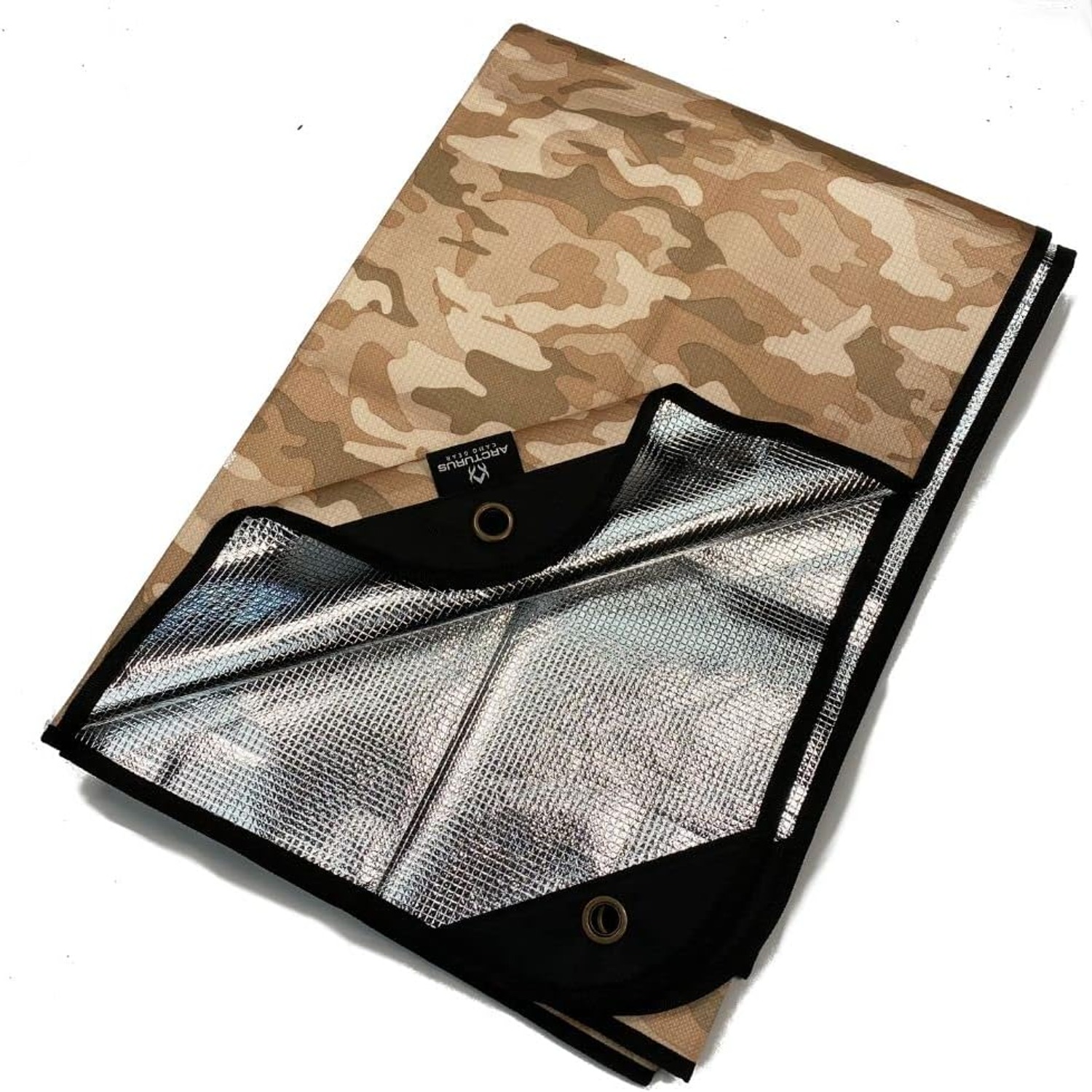
Heat leaves your body in a few ways. Some of it goes into the ground you are lying on, some of it drifts off into the air, and a lot of it radiates away as infrared. The Mylar face on this tarp targets that last one. Turn the shiny side toward you and a good share of that radiant heat comes back instead of disappearing into the night.
The same trick works in reverse. On a hot day, pitch the tarp with the reflective side facing the sun. It sends a chunk of the solar load straight back up, so the air under your shelter stays cooler than it would under a plain dark tarp. People who camp in open country in summer notice this immediately.
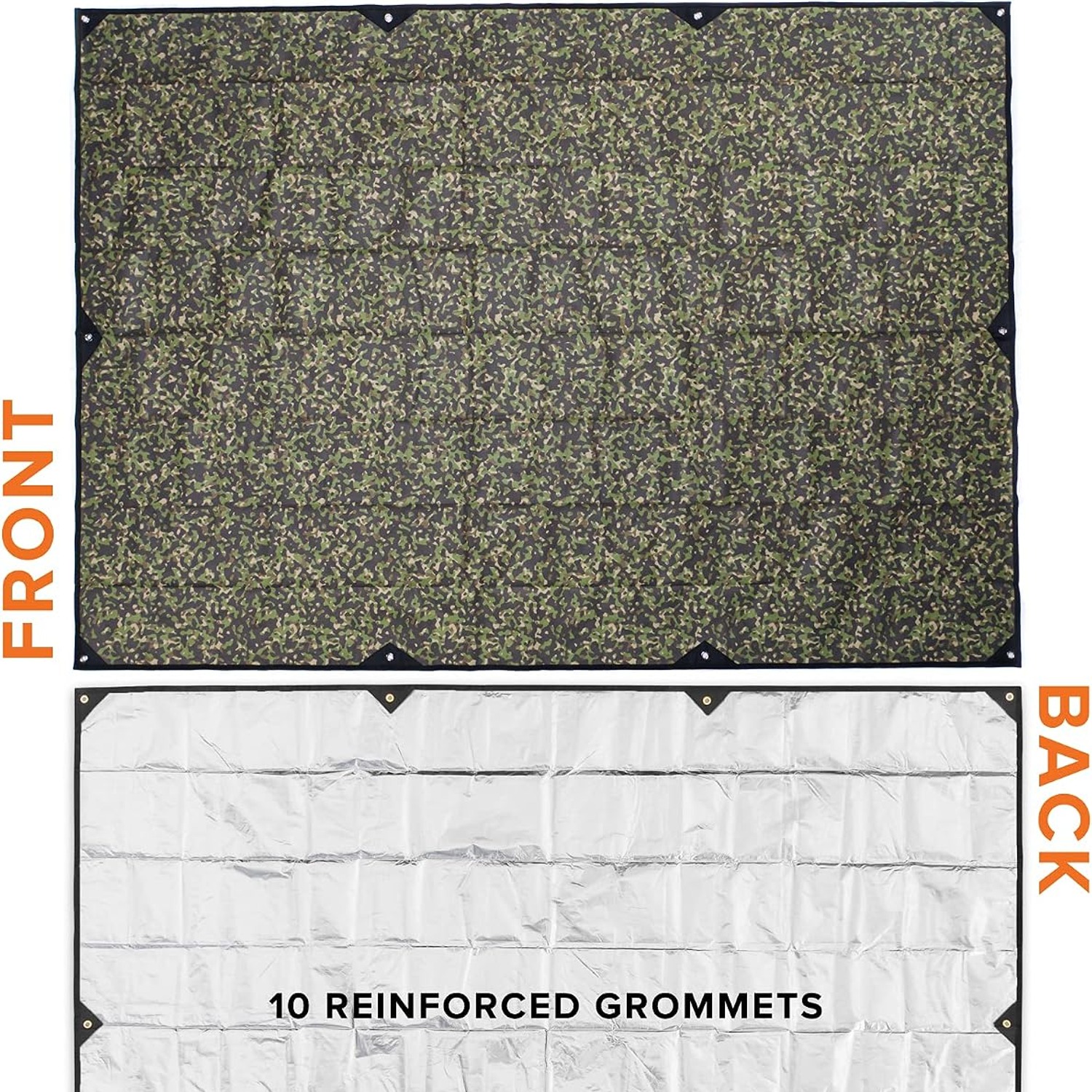
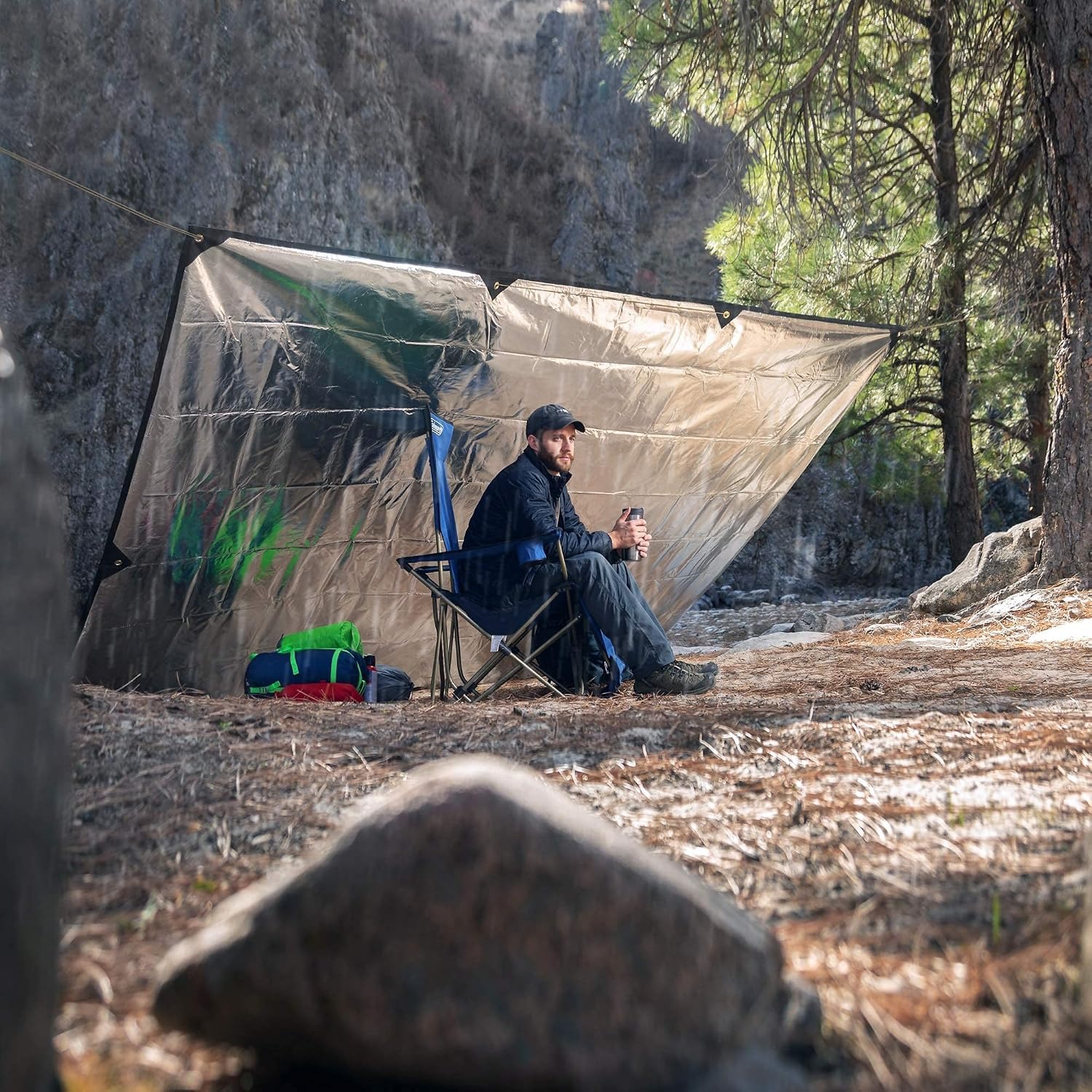
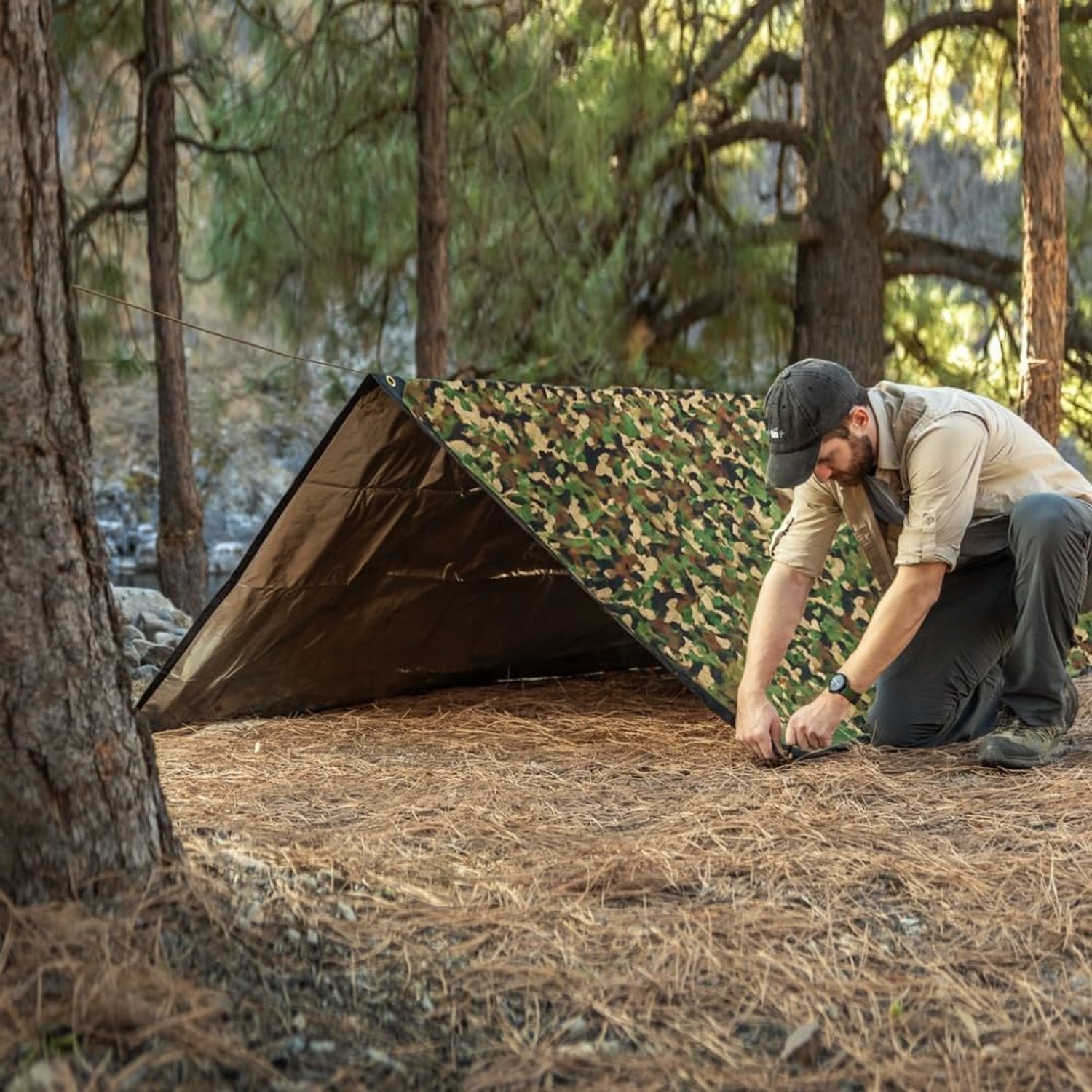
The back of this tarp is doing a different job. Two layers of polypropylene, with aluminium and nylon in the build, give you a waterproof barrier. Water does not pass through it, so it works overhead as a rain fly and underneath as a ground sheet. Lay it reflective side up under your mat and you get both effects at once, a dry barrier below and heat reflection above.
That reflective face has a third use that only matters once, but matters a lot. It is bright. Spread it out in the open and it is visible from the air or from a distance across a valley. If you ever need to be found, you already have the gear.
Who this one suits
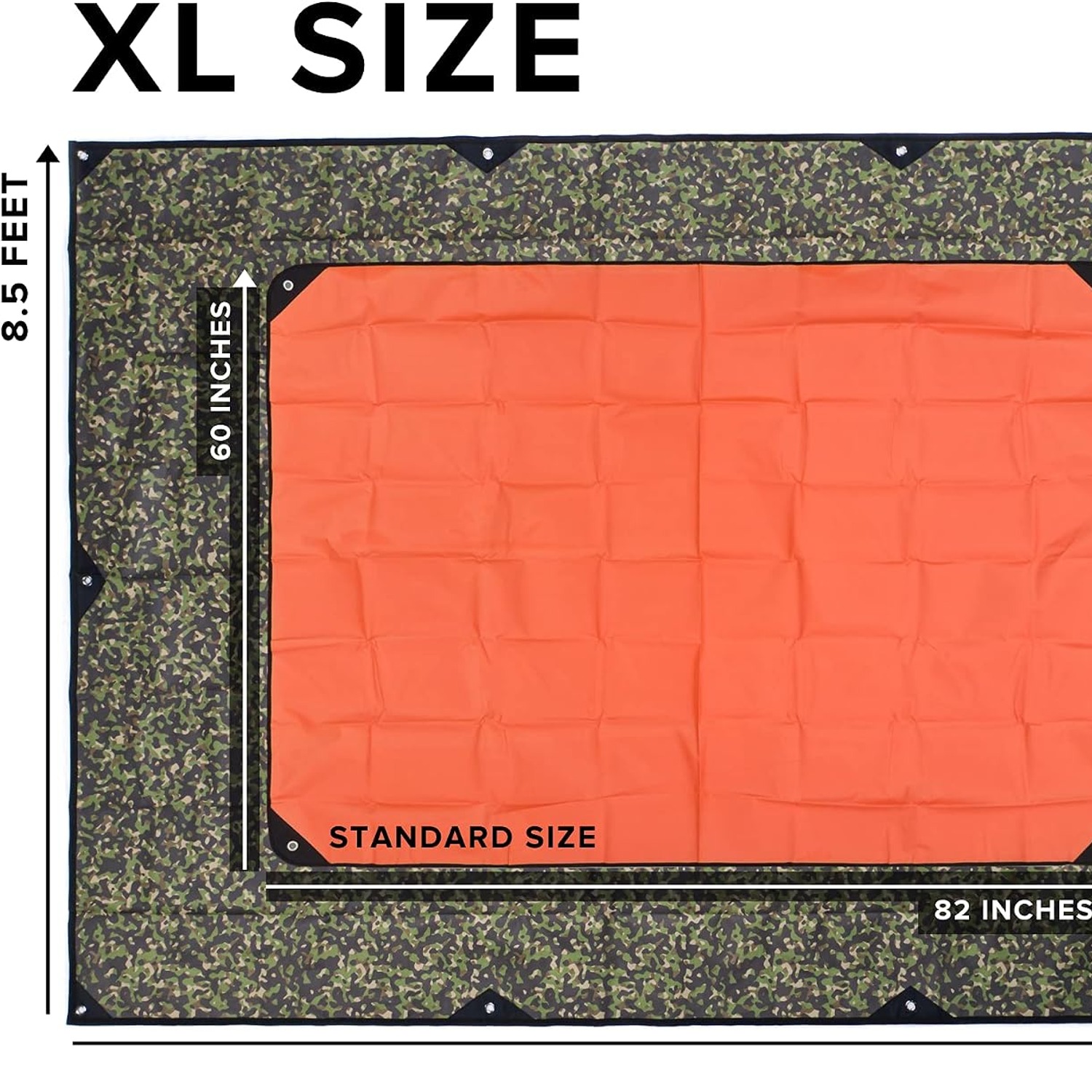
At 2.59 metres by 1.52 metres, this is the extra large version. That size suits a few groups particularly well.
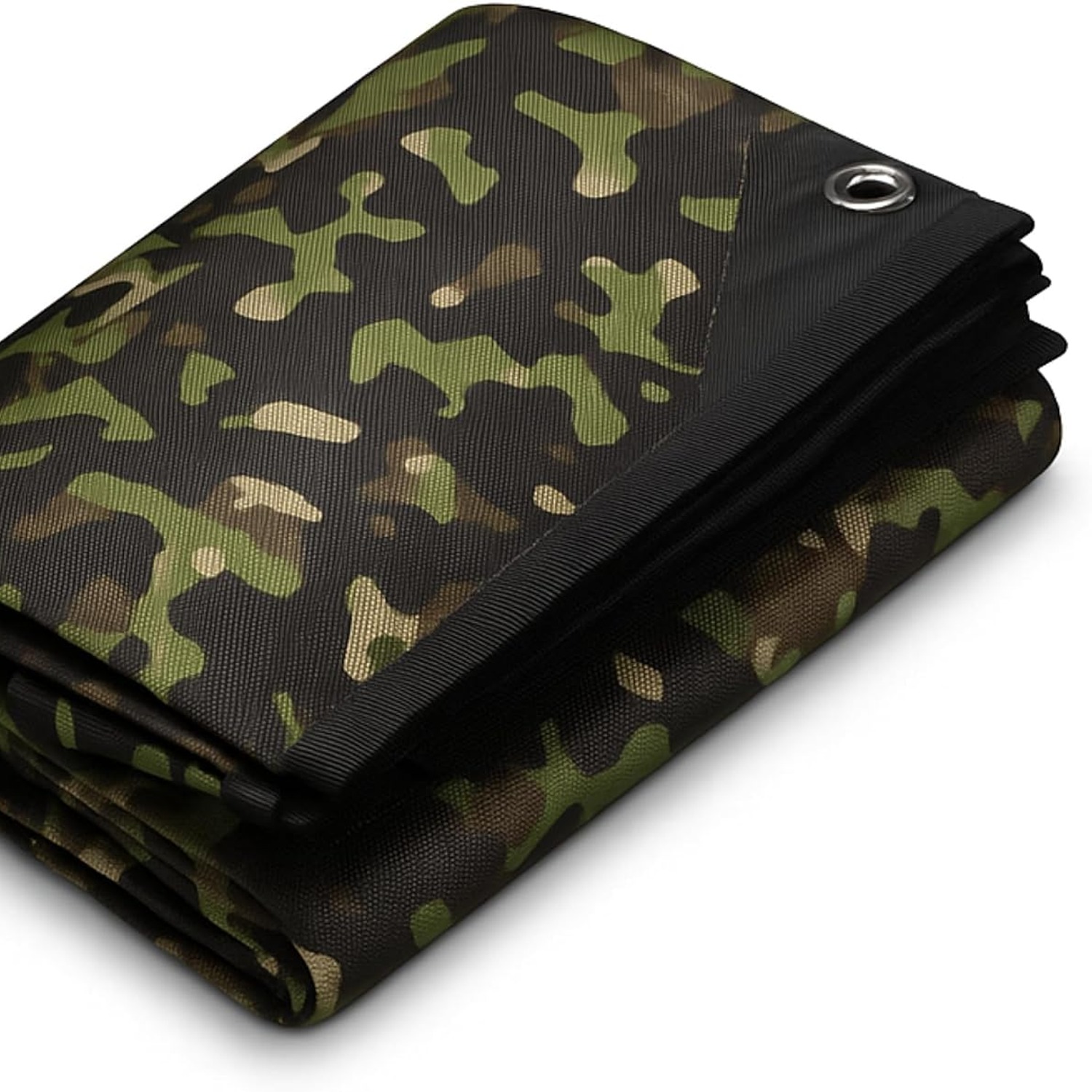
Car owners and anyone building an emergency kit get the most obvious value. It lives in the boot, it weighs 1.63 kg, and it covers a breakdown, a roadside repair in the rain, or a cold wait for a tow. Hunters like the Woodland Camo face because it does not announce itself across a clearing, and hunting is one of the listed uses along with boating and backpacking.
Campers who want one item instead of three also do well here. Rather than carrying a separate ground sheet, emergency blanket and spare fly, you carry this. Weekend hikers can manage the weight easily. Dedicated ultralight walkers counting every hundred grams may want something smaller, and that is fair, it is a trade between durability and mass.
Boat owners find a different use again. Lashed over gear with the grommets, it keeps spray off, and it folds flat into a locker when not needed.
What to look for when you choose
Size first. A tarp that is too small is frustrating in a way that nothing fixes. Work out what you need to cover, then add a margin for the angles you will pitch it at. A flat sheet loses effective coverage the moment you tilt it into a lean-to, so the 2.59 m length gives you room to work with.
Then look at the tie-down points, because this is where cheap tarps let you down. A grommet punched straight through thin fabric becomes a tear the first time a gust loads it. The grommets here are claw-style and grip onto reinforced nylon patches, so the pull spreads out across the patch instead of concentrating on one hole. Ten of them around the edge means you can distribute tension rather than hanging everything off two corners.
Check whether it is genuinely waterproof or just water-resistant. This one is listed as waterproof, which is the difference between sitting out a steady downpour and slowly getting wet through.
Finally, think about weight honestly. People love quoting low numbers, but a 200 gram emergency blanket tears the first time you drag it over a rock. At 1.63 kg this sits in the middle, light enough to carry and tough enough to reuse. For most buyers looking for the best all weather blanket to actually keep, that middle ground is the right call.
Rigging it well
A tarp is only as good as the way you pitch it. Two habits make the difference.
First, use a ridge line. Run cord between two anchor points, lay the tarp over it, and then tie down the corners. The ridge line takes the main load and the tarp hangs off it, rather than the tarp itself carrying all the tension.
Second, leave a little give in your guy lines. A drum-tight pitch looks neat and fails faster. A small amount of slack lets the fabric move with a gust instead of fighting it. If the wind is really up, lower the pitch and pin the windward edge close to the ground.
For a ground sheet, keep the tarp edges tucked slightly under your mat rather than spread wide. A flat sheet that extends past your shelter will catch rain running off the fly and funnel it straight underneath you.
Looking after it
The care here is simple and worth doing. Shake off leaves and grit before packing. If it is muddy, wipe it with a damp cloth and mild soap, rinse lightly, and let it dry all the way through before folding. Putting a damp tarp into its bag is the fastest route to mildew and a smell that never fully leaves.
Avoid folding along the same creases every time. Rolling it loosely or varying your folds keeps the reflective coating from wearing through in lines. Keep it away from fire and embers, since synthetics melt. Store it out of constant direct sun, even though it has UV protection, because nothing survives endless exposure forever.
No machine washing, no tumble drying, no ironing. Hand care only.
The short version
This is an extra large survival tarp with two useful faces. Reflective Mylar on one side for warmth, shade and signalling. Waterproof polypropylene on the other for rain and wet ground. Ten reinforced grommets let you rig it as a shelter, a ground sheet, a gear cover or a wrap.
It measures 2.59 m by 1.52 m, weighs 1.63 kg, comes in Woodland Camo, and arrives with a carry bag. It is listed for backpacking, boating, camping, emergency preparedness, hiking and hunting, which is a fair summary of where it earns its place.
Buy it if you want one piece of kit that handles cold, rain and sun without taking up much room. Keep it in the car, the pack or the camping box, and you will be glad it is there the day the weather turns.