
The complete guide
How to Choose a Rechargeable LED Headlamp
The problem with holding a torch in your teeth
Everyone has done it. You are kneeling in the dark trying to thread a tent pole, or reaching into an engine bay, or tying a hook with cold fingers, and the only light you have is a hand torch you cannot hold. So it goes in your mouth, or under your chin, or propped against a rock where it lights everything except the thing you are working on.
A head torch fixes that in the simplest possible way. The light goes where your eyes go, and both hands stay free. That sounds obvious, but the difference between a torch and a headlamp shows up the first time you actually need two hands in the dark.
The catch is that headlamps vary a lot. Some are too dim to be useful past a metre. Some are so heavy they give you a sore neck after twenty minutes. Some eat AAA batteries. And plenty of them have one beam that is either too narrow or too wide for whatever you are doing. Knowing what to look for saves you buying two or three before you land on one that works.
What the numbers actually mean
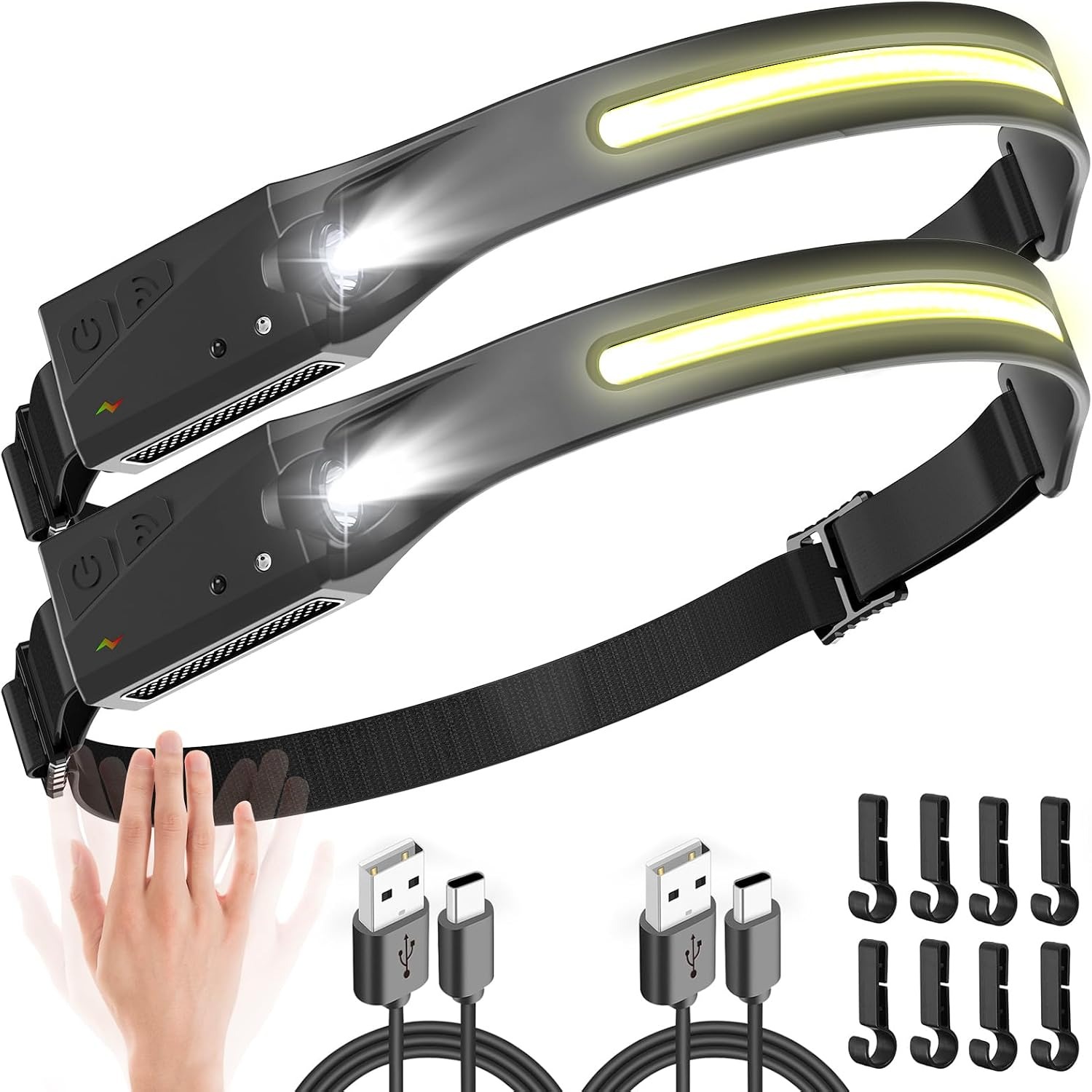
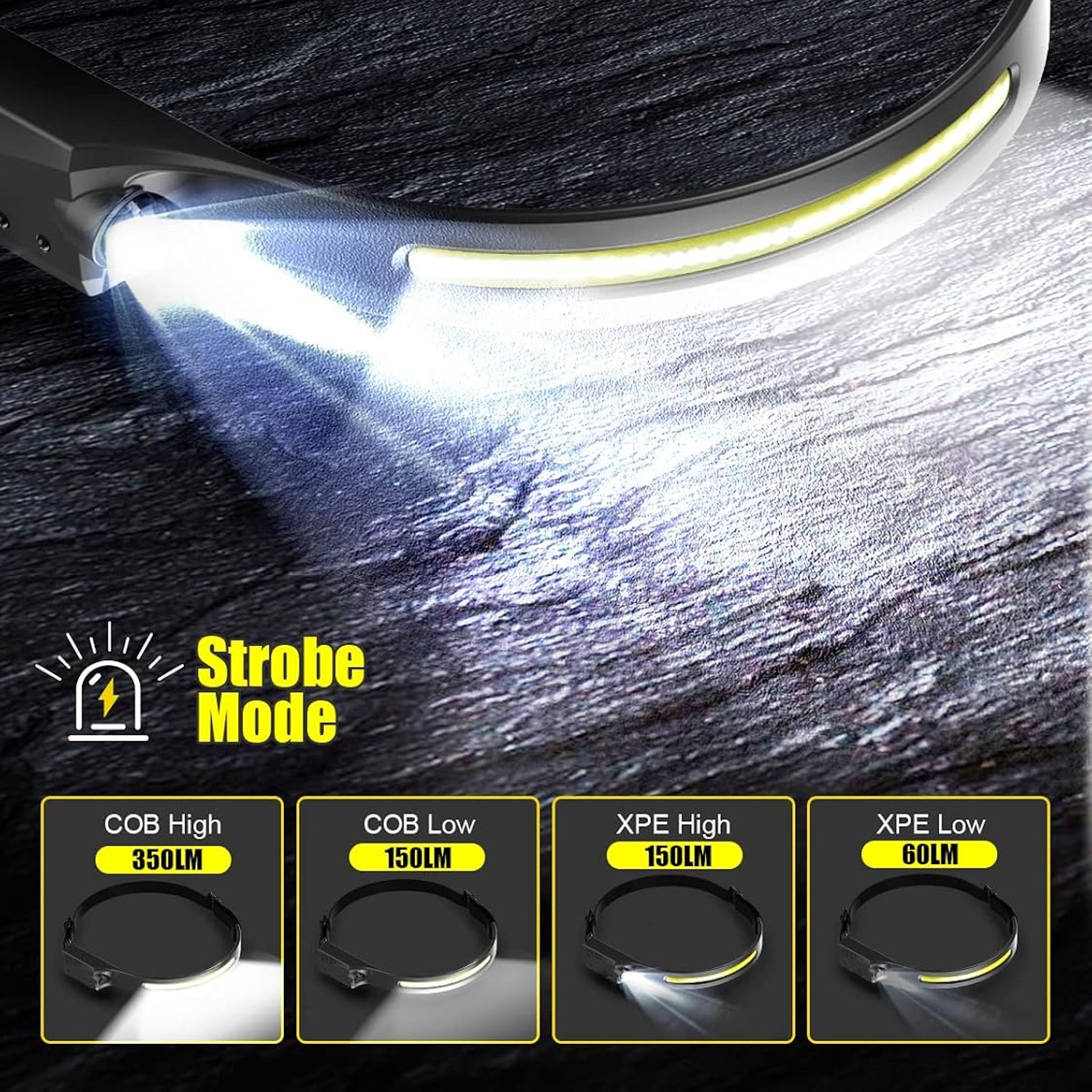
Lumens measure total light output. This model puts out 350 lumens at full power, which sits in a practical middle ground. Under about 150 lumens you start struggling outdoors. Above 500 you are into territory where the light is overkill for close work and the battery drains faster. For camping, repairs, walking and fishing, something around 300 to 400 lumens covers almost everything.
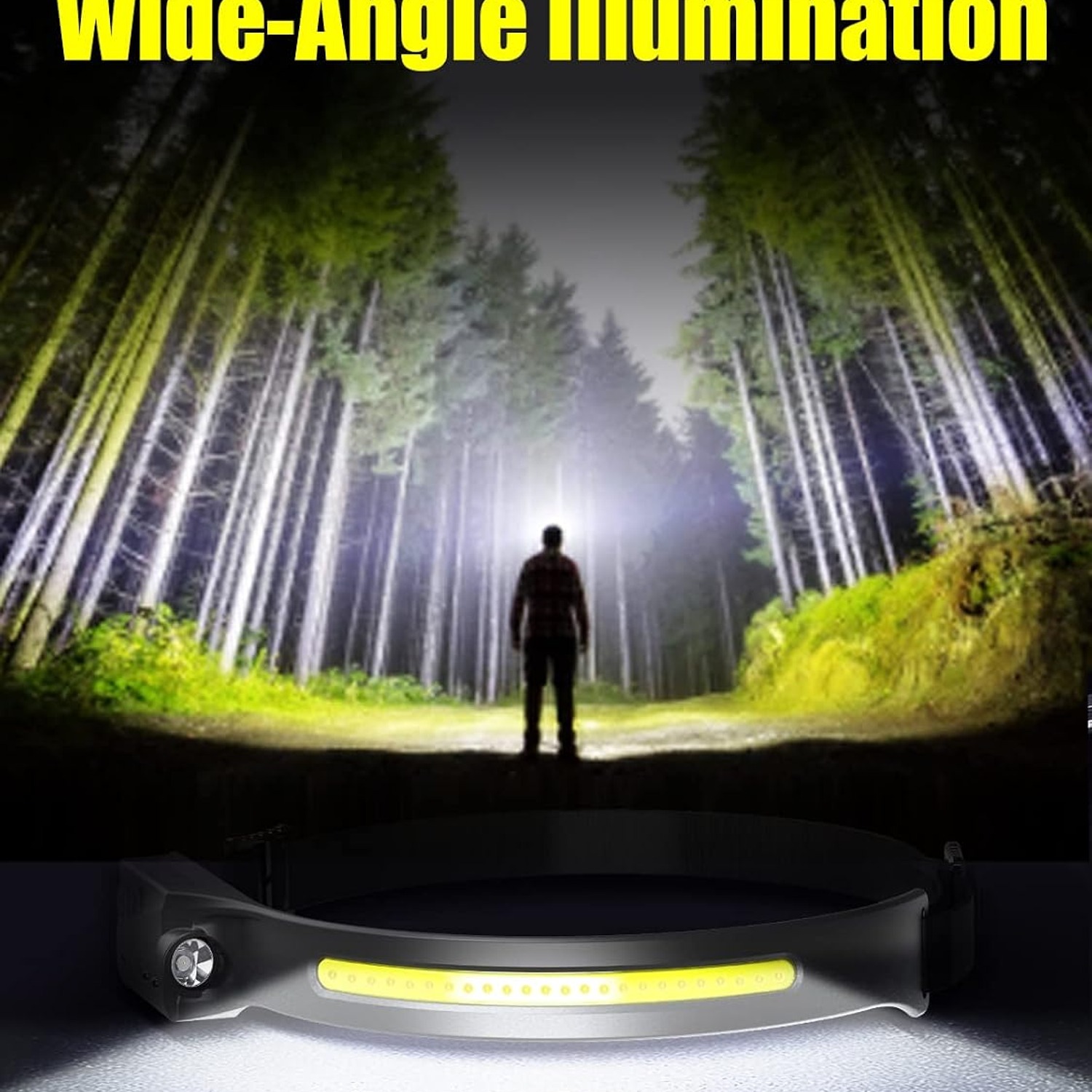
Beam angle matters just as much as brightness, and most people never check it. A 230 degree spread, which is what the COB strip here produces, means the light fans out wide instead of punching a narrow hole in the dark. Wide beams are what you want for anything happening within arm's reach. Narrow beams are for distance.
That is why having both matters. The second source, an XPE spot, throws light up to 300 metres. You are not going to use that walking around camp, but you will use it when you want to check what made a noise at the edge of the clearing, or find a track marker, or see how far the path drops away.
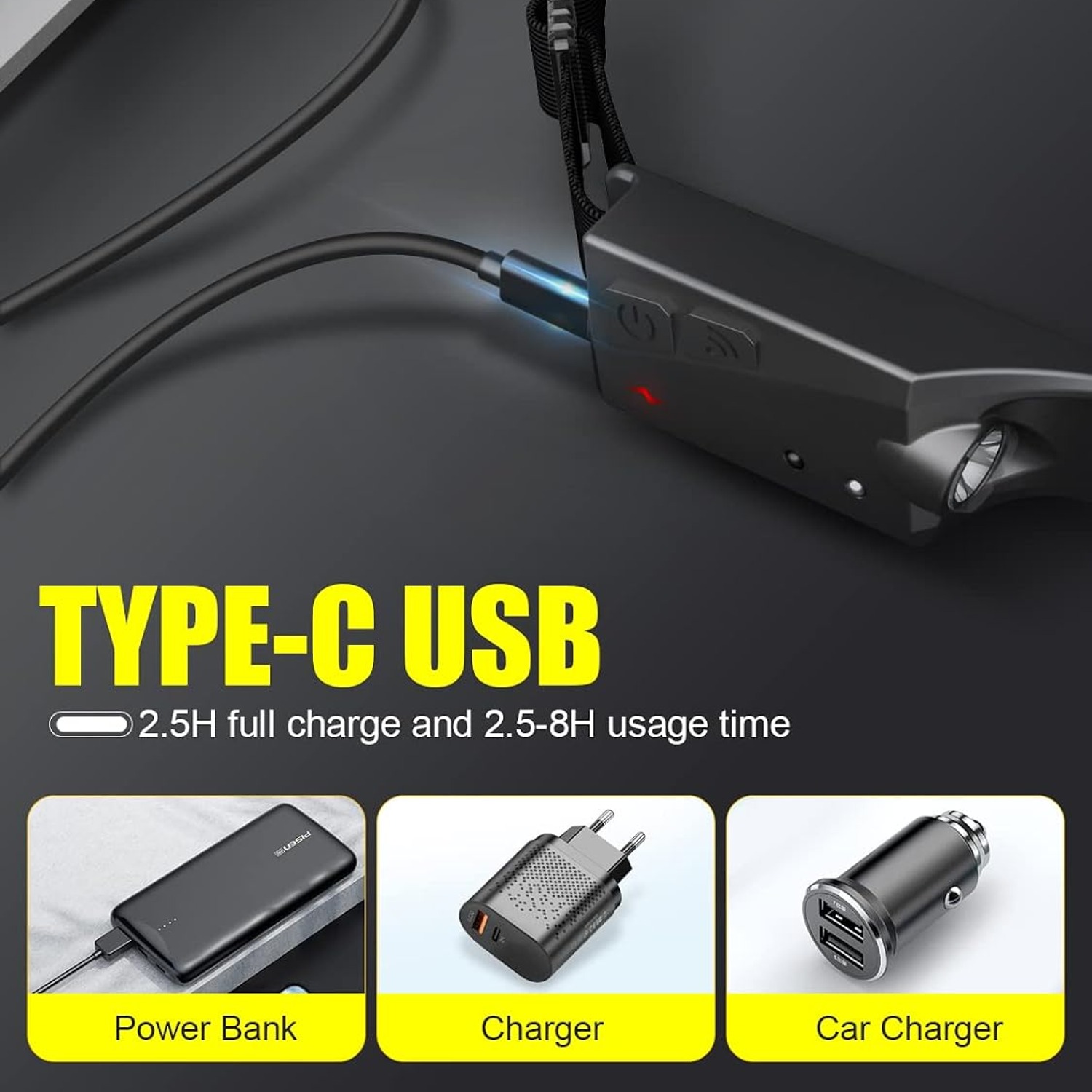
Runtime of up to 8 hours is the figure quoted, and like every runtime figure it depends on which mode you run. Full power on either source drains faster than the 40 per cent settings. In practice, most people spend most of the night on a low setting and only reach for full output occasionally, which stretches a single charge across a weekend.
Why the motion sensor is not a gimmick
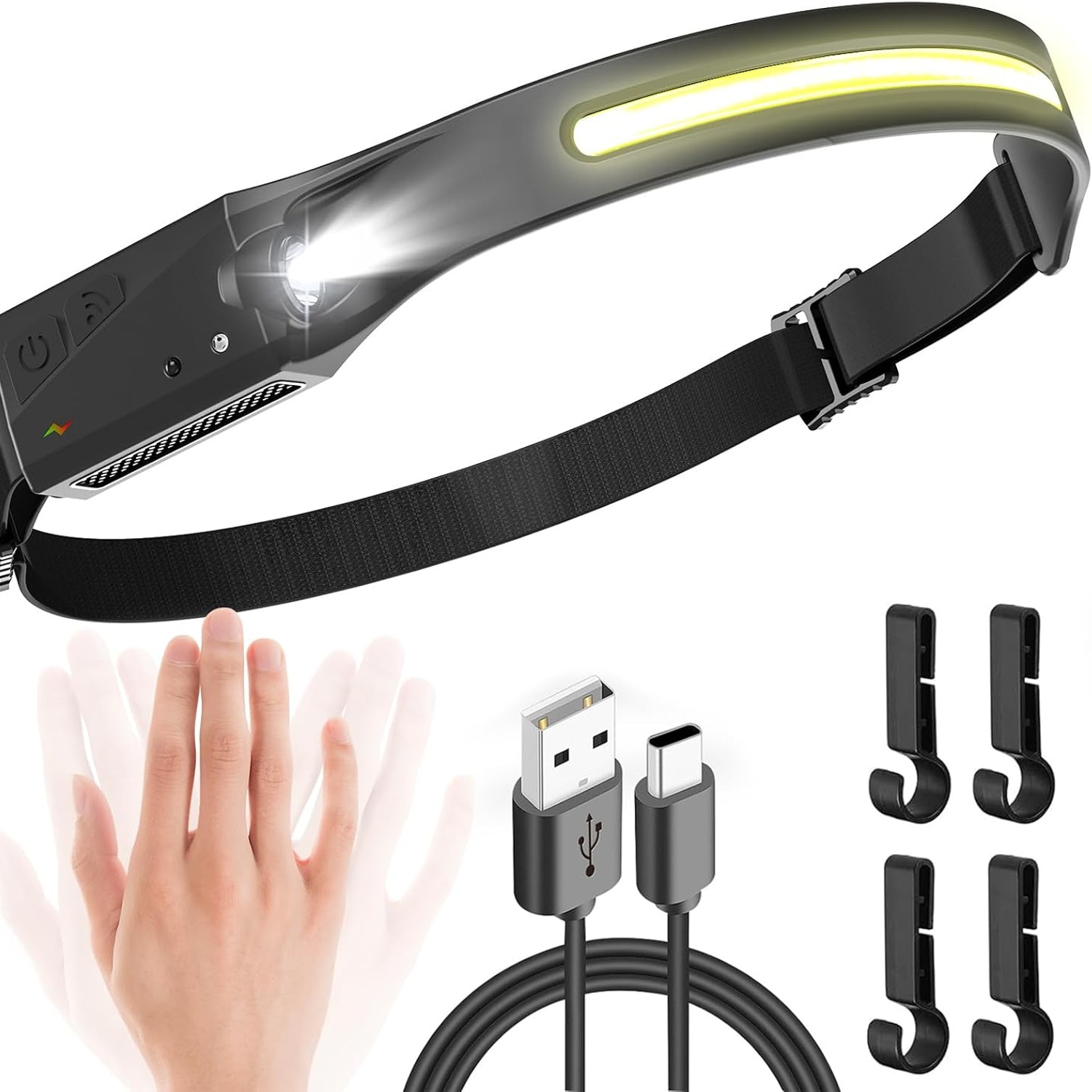
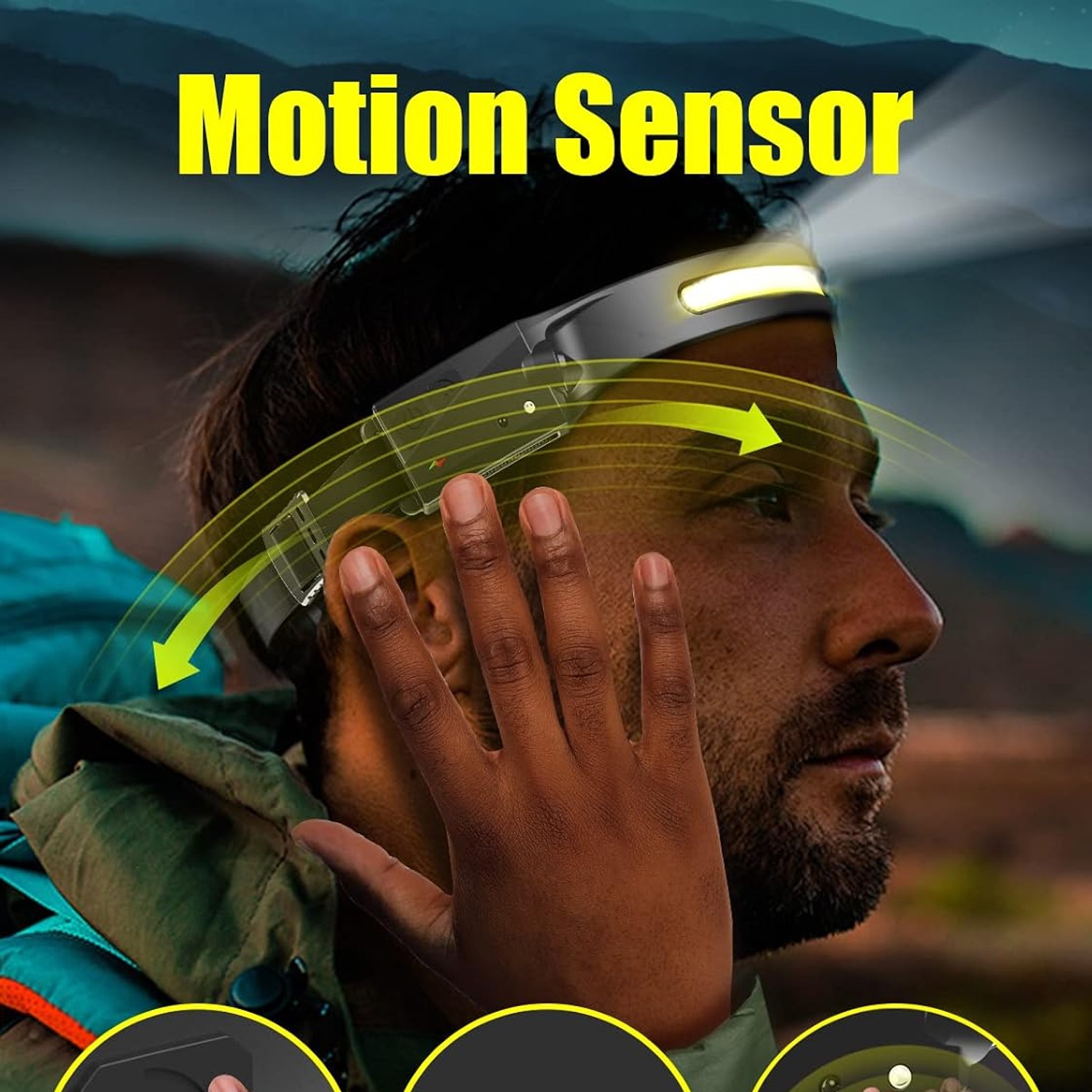
Wave-activated lights sound like a novelty until you use one with dirty hands. The sensor on this lamp turns the light on and off when you pass a hand in front of it. No button, no removing the lamp, no smearing grease across the housing.
If you work on cars, fix things, fish, or cook at camp, that comes up constantly. You need the light on, then you need it off because it is blinding the person opposite you, then you need it on again. Doing that with a wave rather than a press is a small thing that stops being small after a few nights.
It does mean the lamp can switch when you are working right in front of it. Most people adjust within an hour, learning roughly how close triggers it. The physical control is still there if you want to lock in a mode and forget about it.
Charging, and why USB-C is worth caring about
Disposable batteries in a head torch are a quiet annoyance. They go flat at the worst time, they cost money every season, and they leak if the lamp sits in a drawer for a year.
This one has a built-in lithium ion battery and charges over USB-C with the cable supplied. That is the same connector as most recent phones, tablets, laptops and power banks, so you are not carrying a special cable. On a trip you can top it up from a car socket or a portable battery.
The trade-off with built-in batteries is that you cannot swap in a fresh cell mid-use. That is the main reason the two pack makes sense for longer trips. Charge both, use one, keep the other as your backup. It is also why we suggest giving the battery a top-up every few months if the lamp is sitting unused, since lithium ion cells are happier stored part-charged than flat.
Fit, weight and wearing it for hours
At 80 grams, this is a light headlamp. Weight is the single biggest factor in whether you actually wear a head torch or take it off after ten minutes. Heavier models, particularly ones with a rear battery pack, start to feel like something strapped to your skull.
The headband is soft elastic silicone, which does two things. It grips without digging in, and it stretches over a helmet or a beanie. Adjust it before you need it, not when you are already halfway up a trail. A band that is slightly too loose will bounce with every step, which is distracting and also means the beam is never quite where you want it.
The housing is ABS with silicone, described as impact resistant. Head torches get dropped, sat on, and thrown into gear bags. A hard plastic shell handles that better than something lighter and more fragile.
Who this suits
Campers are the obvious group. Setting up after dark, finding the toilet block, cooking, reading in a tent, these are all wide-beam jobs with the occasional need to look further out.
Mechanics and DIY users get a lot out of the combination of wide beam and wave sensor. So do anglers, especially at night, where the flood lights your tackle and the spot lets you watch the water.
Runners, walkers and dog owners want the light weight and the flashing mode. Cyclists can use it as a secondary light that follows where they look, though it does not replace a proper regulated front light where local rules require one.
And anyone who just wants a reliable light in the house for a blackout will find a head torch more useful than a hand torch. You can carry things with it on.
Water, weather and what water resistant means
The lamp is listed as water resistant. In normal terms that means rain, drizzle and splashes are fine. Walking home in a shower, fishing in light rain, washing up at camp, none of that is a problem.
What it does not mean is submersion. Do not drop it in a creek and expect it to be fine. If it does get properly wet, dry the outside and make sure the USB-C port is completely dry before you plug anything in. Charging a wet port is the quickest way to kill any rechargeable device.
Simple care that makes it last
Wipe the housing with a damp cloth after a dusty or muddy trip. The band can be hand washed and air dried if it gets sweaty. Keep it out of hot cars and direct sun, since heat is hard on both plastics and lithium ion batteries.
Before any trip, charge both units. It takes nothing to do and it is the difference between a working light and a dead one. If the lamps are going into storage for a season, give them a charge every few months rather than leaving them flat.
The short version
If you need light and both hands at the same time, a head torch beats a hand torch every time. Look for something around 300 to 400 lumens, with a wide beam for close work and a spot for distance, that charges over USB-C and weighs little enough that you forget it is on your head.
This pack ticks those boxes with two 350 lumen lamps, a 230 degree flood, a 300 metre spot, five modes, a wave sensor and an 80 gram body. Two units means a spare, a gift, or one in each vehicle.
If you are still weighing up whether you need the wide beam or the long throw more, send us a note about how you plan to use it and we will give you a straight answer.